3D DOSIMETRY
Making radiation which can’t be seen/smelt/felt, visible
3D dosimetry is a radiation measurement technique that produces three-dimensional dose distributions in radiation therapy and nuclear medicine. Several types of 3D-dosimeters are commercially available: (i) in hydrogel dosimetry, monomers that polymerize upon radiation are used and the read out is via magnetic resonance imaging (MRI) or optical computed tomography (OCT), (ii) in radiochromic gel & solid plastic dosimeters, a dye that irreversibly change color (optical density) when exposed to ionizing radiation and (iii) in scintillation dosimetry, solid materials or gels containing scintillation material emit or modulate light proportionally to absorbed energy are used.
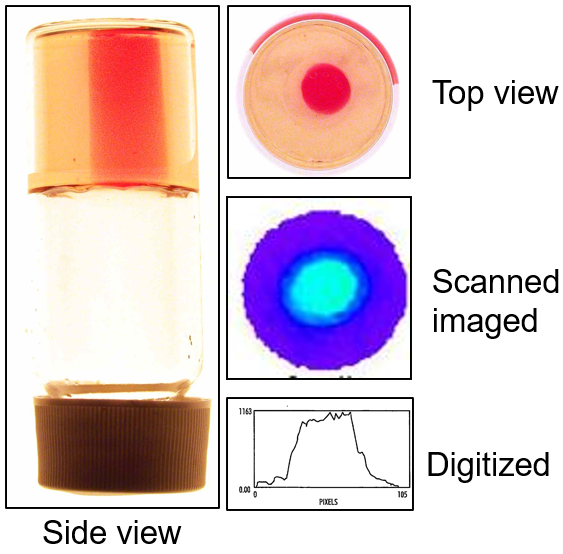
We developed solid and gel 3D dosimetry in 2001-2002. We used a highly sensitive radiochromic dye in a solid polymer and a gel. When radiated, it developed a 3D-image as shown below. A patent was issued in Canada and was filed in other countries. However, after the September 11, 2001 incident, we were busy for some years in developing instantly color developing emergency radiation dosimeters, RADTriage and RADSticker and could not fully optimize our 3D-dosimeter. Today, we have superior materials for 3D dosimetry.